Why Your AI Meeting Notes Are Only Half the Story: The Case for Real-Time Assistance
Post-meeting transcripts help you remember what happened. But real-time AI during calls helps you perform better while it's happening — and that gap is where meeting outcomes are won or lost.
The meeting ends. You open the transcript. There it is, third paragraph down: the prospect said their current tool is "way too expensive" and asked whether you had a lower tier. You said you'd follow up.
You shouldn't have said that. Your lower tier was available, and you had the pricing deck open in another tab. But in the moment, you blanked. The AI notetaker captured every word. It just wasn't there when you needed it.
That's the gap. And it's bigger than most people using AI meeting tools realize.
Recall Isn't Performance
Meeting notes tools — Otter, Fireflies, Granola, most of the category — solve a real problem. They capture what happened so you don't have to hold it all in your head. That's genuinely useful. But capturing what happened and helping you perform better while it's happening are two completely different jobs.
Recall is retrospective. Performance is live.
You can have perfect recall and still lose the deal, miss the deadline, or leave the critical question unanswered. The transcript documents the loss. It doesn't prevent it.
This isn't a knock on transcription tools — they're good at what they do. The issue is category confusion. Somewhere along the way, "AI meeting assistant" became synonymous with "AI notetaker," and most people accepted that as the whole job. It isn't.
Three Moments That Change the Outcome
The Objection You Don't See Coming
A buyer pushes back on implementation timeline. You've handled this objection dozens of times, but right now you're also reading body language, noting who else is on the call, and trying to recall what they said about their Q3 board meeting fifteen minutes ago. Your brain is full.
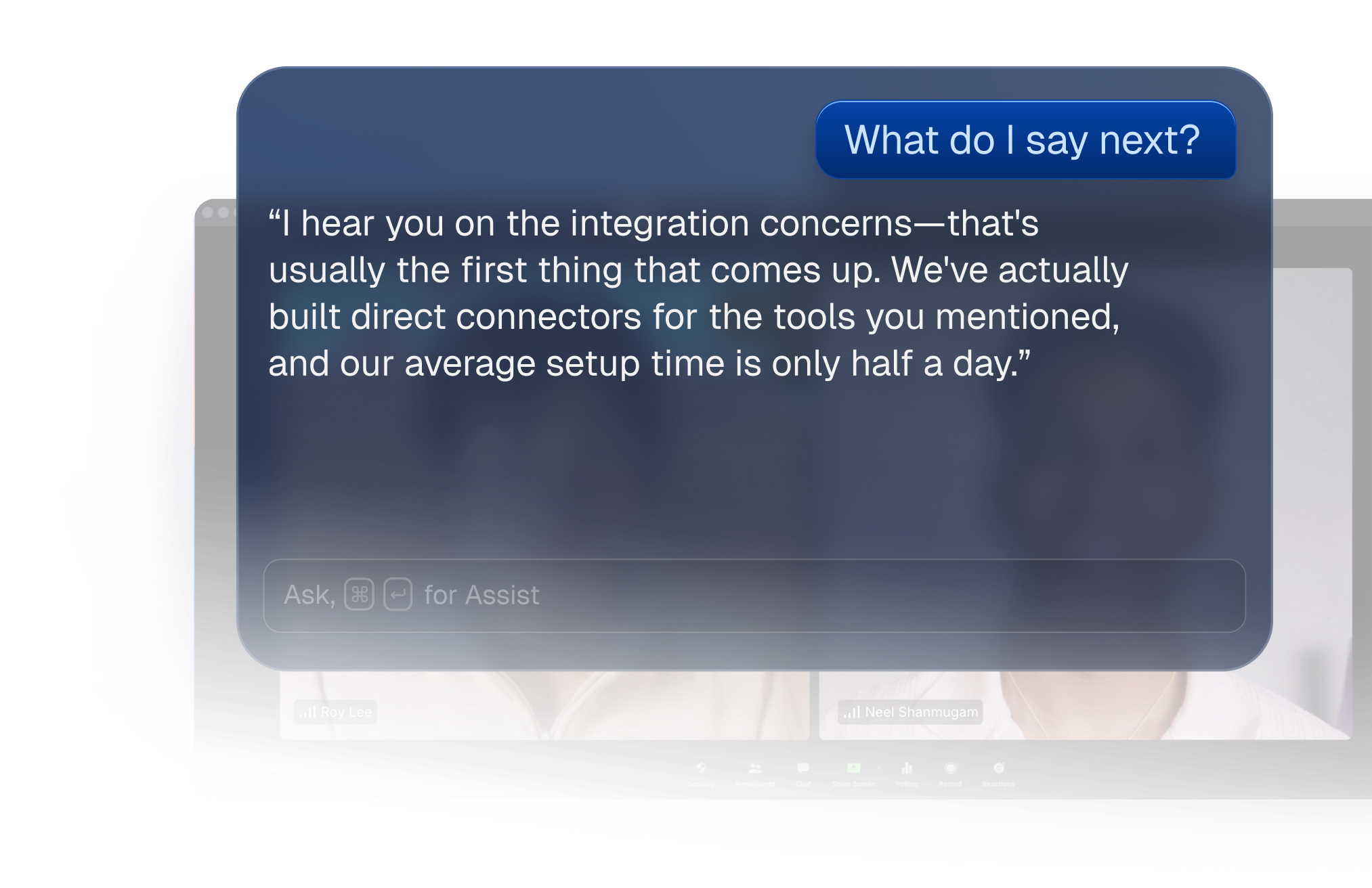
A real-time AI meeting assistant has full context of everything spoken in that call. It can surface the relevant detail exactly when you need it: "They mentioned needing this live before their August board meeting." Now your response is specific instead of generic. "Given your August deadline, here's exactly how we'd phase the rollout" closes faster than "we've helped companies similar to yours."
The Stat You Can't Quite Remember
You're mid-sentence on ROI and you know there's a number — 40% reduction in ramp time, or was it 35%? You don't want to say the wrong figure on a recorded call. So you hedge: "Companies typically see significant improvements..." The moment lands flat.
Real-time AI can feed you the right number before you finish the sentence. No hedging required.
Action Items That Calcify
Here's a consistent failure mode in long meetings: action items get assigned verbally, everyone mentally notes them, and then two people leave with different understandings of who owns what. A post-meeting transcript captures it all — but the confusion tends to harden in the gap between the call ending and the follow-up email going out.
An AI that flags ownership commitments as they're spoken — not an hour later in a summary — creates a different kind of accountability. The divergence never gets a chance to form.
Why Transcription-First Tools Have a Structural Blind Spot
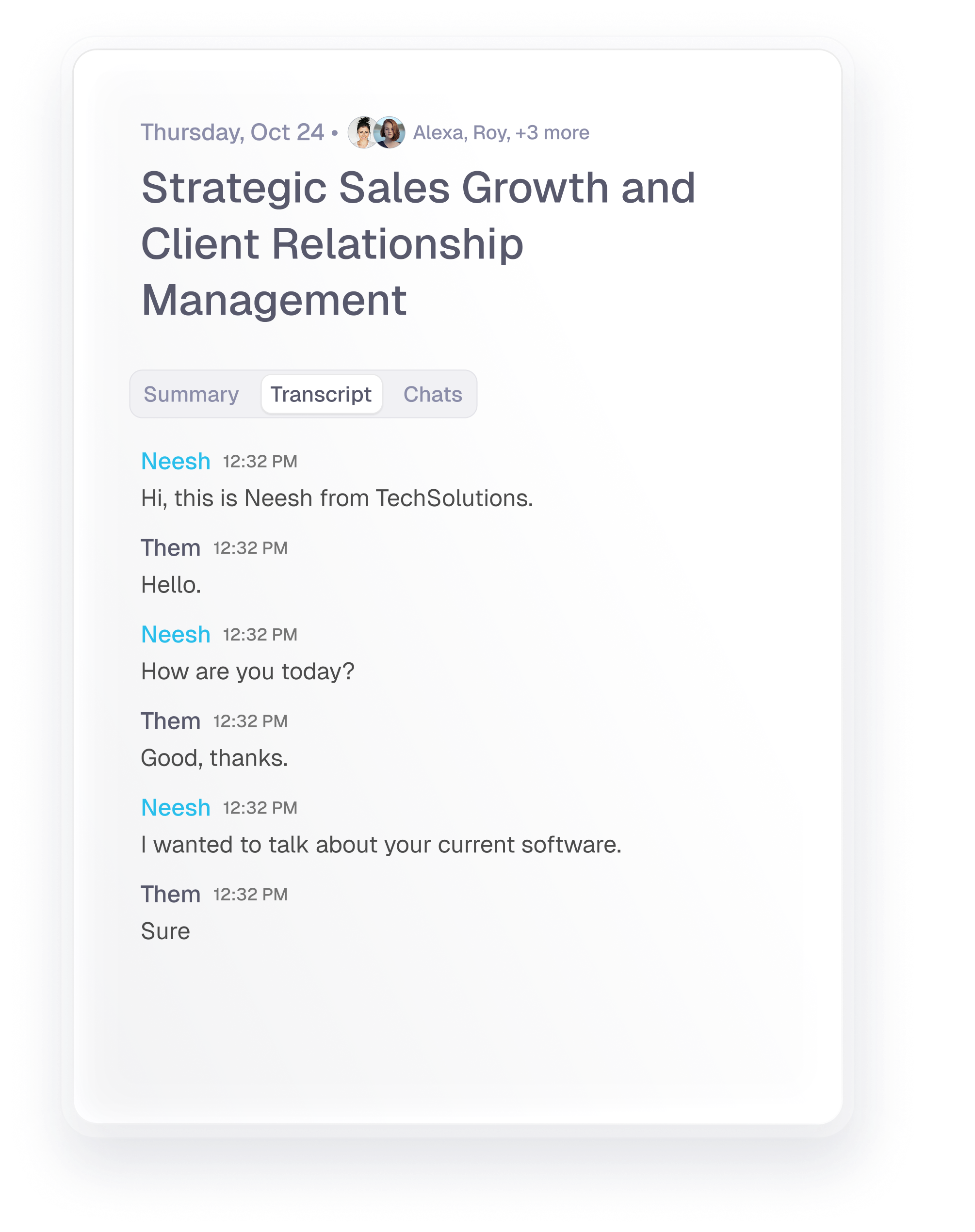
Otter, Fireflies, and Granola are built around a single moment: after the call ends. Their core loop is record, transcribe, summarize, deliver. That loop is optimized for what you'll want to review tomorrow morning.
This isn't a product failure. It's a product choice. Building for the post-meeting moment lets you optimize for transcription accuracy, summary quality, CRM integration, and searchable archives. Those are real features that real people use.
But all of those features require the meeting to be over. And the meeting being over is the whole problem.
Real-time assistance operates under a fundamentally different constraint: low latency, contextual relevance to the current moment in the conversation, and output that's actionable in two seconds or less. You can't bolt that onto a transcription-first architecture. It requires building for the meeting as it's happening, not building for the recap.
Cluely Runs During the Meeting
Cluely was built for the in-meeting moment. It runs alongside your calls — Zoom, Meet, Teams — and maintains a live understanding of the conversation as it unfolds. When you need a talking point, a stat, or context from earlier in the call, it's there without stopping to search.
The design assumption is different from transcription tools. Cluely treats the most important moment as right now, not after you hang up.
Cluely does produce a post-meeting summary. That's not an afterthought — clean documentation matters. But if the tool only activates after the call, it's leaving the hardest, highest-stakes part of the job unaddressed.
If you spend three or more hours a day in calls and leave some of them thinking "I should have said that" — a real-time AI meeting assistant is built for exactly that gap. The transcript is the record of what happened. Cluely is what changes what happens.